Is Gel Coat Wax Different Than Car Wax?
Can you use a standard gel coat wax on your boat, or do you actually need a more aggressive product?
Many boat owners suspect that the industry simply slaps a picture of a boat on a car wax bottle just to charge a premium and separate you from your money.
The confusion is real, and even as a veteran professional detailer, I constantly have to read between the lines of marketing labels to find real value. Boat care can quickly make you feel like you're chasing your tail.
I constantly hear from frustrated owners asking a version of this exact question:
"Darren, I am tired of trying to figure out the difference between car wax, gel coat wax, and fiberglass boat wax. Is there a real difference, and what do you recommend as a professional?"
To answer that honestly, we have to look at the massive physical differences between the clear coat on your car and the gel coat on your boat.
Gel Coat vs. Automotive Clear Coat
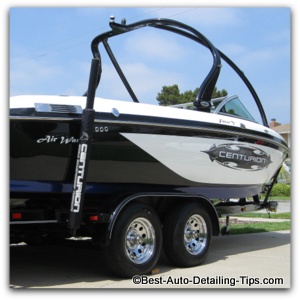
It is common to put car care and boat care into the same category, but treating them exactly the same is a mistake. While a few finishing products can cross over, the material on the surface of your boat is fundamentally different from the paint on your car.
To choose the right products, you have to understand the actual chemistry of your boat's surface:The Bathtub Analogy
- Fiberglass vs. Gel Coat: People often use these terms interchangeably, but they aren't the same. Fiberglass is the structural foundation—the cloth and resin that give the hull its strength. Gel coat is the specialized, pigmented resin layer applied over the fiberglass to give the boat its smooth, colored outer shell.
- High Porosity: Unlike the hard, non-porous clear coat on modern cars, gel coat is highly porous. This makes it far more susceptible to absorbing contaminants and oxidizing rapidly when exposed to UV rays and water.
- The Need for Protection: Because of this porosity, boats require heavy-duty protection to prevent severe oxidation, dulling, and chalking. They need to be sealed and waxed just like cars, but with products designed to fill those open pores.
The Bathtub Analogy
To visualize this, think of a standard fiberglass home bathtub. It is built using the exact same molding process and gel coat materials as your boat.
The difference lies in how we maintain them. We use aggressive, abrasive cleaners and scrub brushes on our bathtubs regularly, which prevents soap scum and dullness from building up. Yet, most boat owners would never dream of taking a household abrasive cleanser to their boat’s finish—even though the material itself could handle the heavy mechanical decontamination required to keep it from oxidizing.
Why Traditional Car Waxes Fail on Boats (and My #1 Recommendation)
Because gel coat is so porous, it begins oxidizing the moment it hits the sun and water. This creates a hidden trap for boat owners.
When you look at your boat, it might still look relatively shiny. So, you grab a standard, non-abrasive "pure" wax, apply it, and expect a mirror finish. Instead, you get a blotchy, hazy mess that disappears in a few weeks.
Here is why that happens—and the professional rule you need to follow instead.
The Hidden Layer of Oxidation
Even if your boat looks clean and shiny, there is always a microscopic layer of dead, oxidized gel coat sitting on the surface.
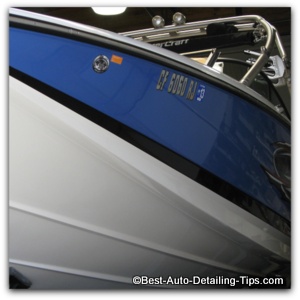
If you apply a pure wax or sealant directly over this layer, you are literally locking in the dead paint. The wax cannot properly bond to the porous gel coat because the oxidation acts like a barrier.
This brings us back to the bathtub analogy:
Think of your boat like your fiberglass home bathtub. If your tub gets a dull film of soap scum and hard water, you don’t just slap a coat of wax over it—you use an abrasive cleanser to scrub the dead film away first. Your boat requires that exact same mechanical cleaning to expose the fresh, vibrant gel coat underneath.
My Default Recommendation: Use a "Cleaner Wax" or "One-Step" Product
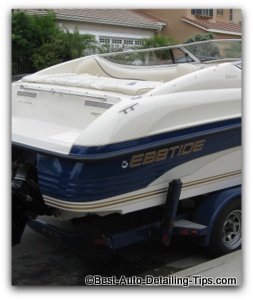
Because of this constant, rapid oxidation, my absolute default recommendation for any boat owner is to never use a pure wax. Instead, you should always use a product that contains chemical cleaners, micro-abrasives, or both. These are typically labeled as:
- Cleaner Waxes
- Polish-and-Wax (All-in-One) products
- Marine One-Steps
The Compelling Case for Cleaner Waxes
By switching to a cleaner-wax or marine polish-and-wax, you achieve three things at once that a standard car wax simply cannot do:
- Deep Decontamination: The micro-abrasives and chemical cleaners mechanically strip away that invisible layer of chalky oxidation, revealing the true gloss hidden underneath.
- Pore-Filling Bonding: By cleaning the pores of the gel coat while you apply the protection, the wax can actually bite into the surface and form a durable bond.
- Massive Time Savings: Instead of compounding the boat to remove oxidation and then waxing it (a grueling two-step process), a quality cleaner-wax lets you clean, polish, and protect in a single pass.
If you want professional results that actually last, stop trying to wax over the dead surface. Prep and protect at the same time with a dedicated cleaner-wax, and let the abrasives do the heavy lifting for you.
Gelcoat Cleaner Waxes: Top Picks
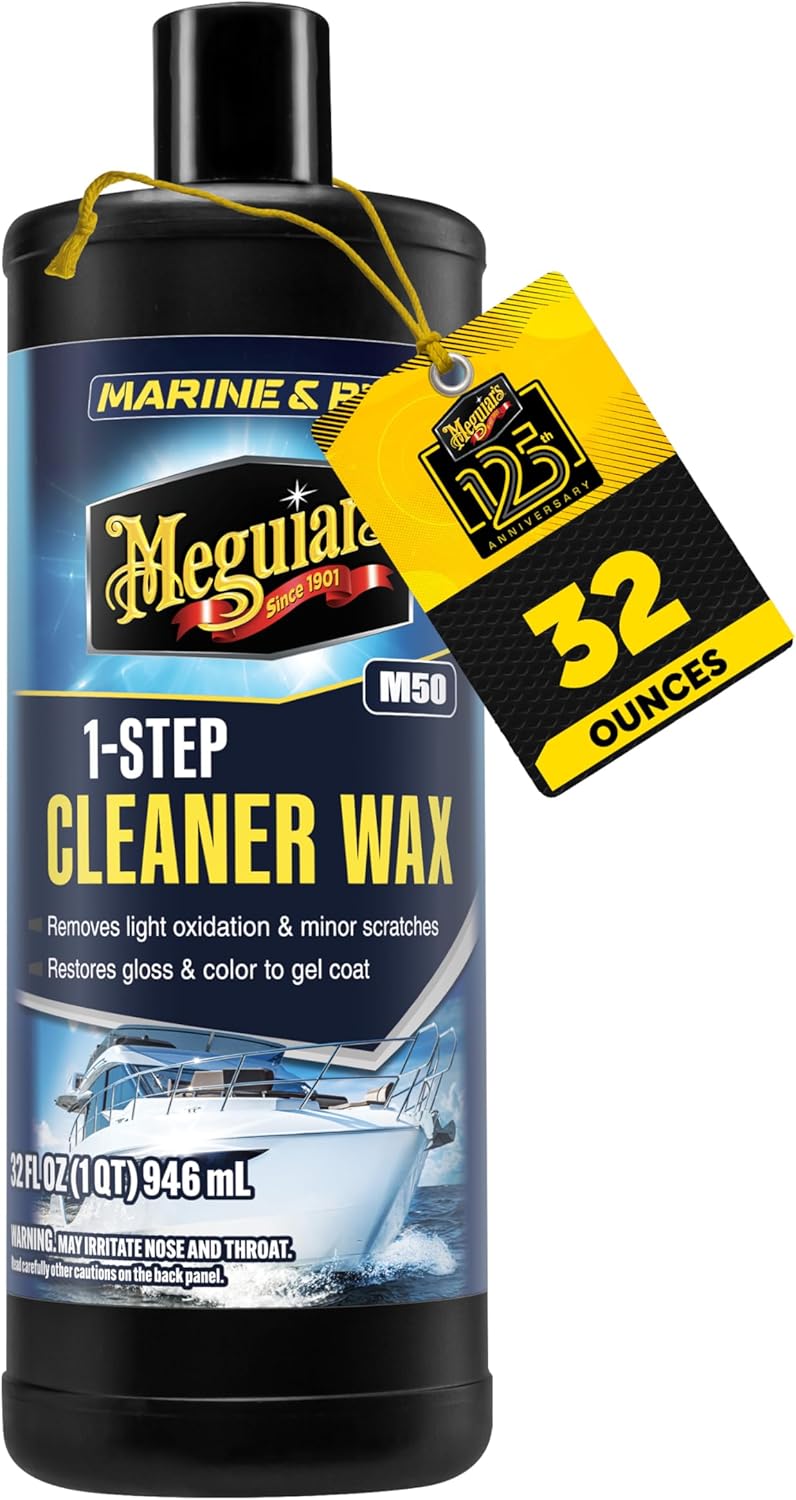
Meguiar's Cleaner Wax on Amazon
- One-Step Care: Simplify your maintenance routine by restoring and protecting your fiberglass gel coat surface in a single, easy application.
- Defect Removal: Confidently eliminate light oxidation, haze, minor scratches, and swirl marks to reveal a completely rejuvenated finish.
- Revive Color and Gloss: Utilizing specialized chemical cleaners and rich polishing oils, this formula effortlessly restores deep color, brilliant clarity, and high gloss without harsh, heavy abrasives.
- Superior Environmental Protection: Formulated to deliver a durable shield against the harshest elements, effectively defending your boat or RV from salt air, corrosion, and damaging UV rays.
- Versatile Application Methods: Achieve professional results using your preferred method—apply it by hand, with a Dual-Action (DA) Polisher, or with a Rotary Buffer.
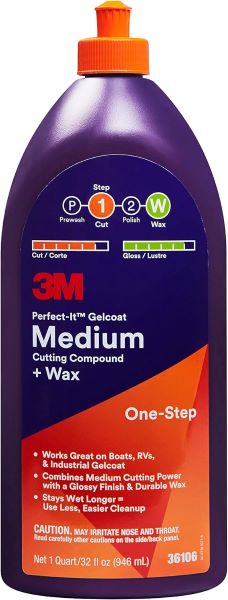
3M Medium Compound and Wax on Amazon
- Professional-Grade Efficiency: Refine, polish, and protect gel coat in a single step, drastically cutting down your detailing time so you can get back on the water or the road.
- Formulated for Marine & RV Surfaces: Scientifically engineered specifically for the unique demands of porous gel coat and structural fiberglass.
- Perfectly Balanced Performance: Easily cuts through moderate oxidation, chalking, and scratches, making it the ideal all-in-one compound for gel coat restoration.
- User-Friendly Application: Optimized for use with a rotary buffer and a yellow 3M wool polishing pad for maximum efficiency, but can also be applied by hand for tight spaces and small areas.
- The 3M Marine System: Fully compatible with the rest of the 3M family. For tailored results, pair with 3M Heavy Cutting Compound for severe oxidation, Light Cutting Polish for minor blemishes, or 3M Boat Wax for an ultra-high-gloss final finish.
Gel Coat Wax Summary
Navigating within the world of car care and boat care is tricky and frustrating at best. Not only will you find endless contradicting opinions among the many car, boat, and RV forums, but ask any of your neighbors or friends and you will only be further frustrated.
Even as a seasoned veteran of professional detailing, I am continually frustrated by the many forms of misleading advertising and product labeling. With that said, it doesn't mean that there is not a shortage of quality products, and just because a manufacturer is less than honest in labeling and marketing doesn't mean they still don't have some exceptional products that continue to get better and better.
Good luck in your efforts!
Sincerely,
Darren Priest
|
|

Thank you for your support of my website. I spend massive amounts of time bringing you my best car care tips that I bring from my 30+ years of experience as a professional detailer.
Sincerely,


Any time you use one of the Amazon links on this website and make a purchase, I earn a small commission (very small). This does not change the price you pay at Amazon, it simply means I earn a commission.
I hope you come back whenever you have any additional questions!