High Speed Buffers
Helping you ask the right questions!
High speed buffers are considered the red-headed step children of the car polishing and detailing world. Unfortunately the wrong people seem to carry the loudest voice when it comes to popular opinions. The online forums are filled with wannabe detailers and so called experts spreading opinions based on limited experience.
And if that wasn't enough, you add further confusion by many other people simply regurgitating bad and unverified information. Anyone looking to take their polishing skills and performance to the next level must seriously consider what the industry has to offer in the way of high-speed polishers.
"My experience has shown that most people don't have enough information to even ask the right questions."
High Speed Buffers:
Asking the right questions
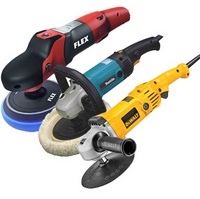

Often we find ourselves making decisions based on partial information; largely because we are all now drowning in this digital sea of free information called the Internet. The Internet now allows virtually anyone a free platform in which to express their opinion, regardless of whether this opinion is good, bad, or even based in any degree of actual experience.
With that said, let me lay out the questions I think you should be asking yourself:
- What is a high-speed buffer?
- What are the different types of buffers?
- How would I know which buffer is the right one for me?
- What buffer do you use?
- Which buffer would you recommend most?
What is a High-Speed Buffer:
In the world of auto detailing and paint and body, a high-speed buffer—most commonly referred to as a rotary polisher—is a machine where the buffing pad spins on a single, fixed axis at high speeds.
Unlike modern dual-action (DA) polishers that both spin and oscillate in an orbital pattern, a rotary buffer moves in a strict, continuous circle. This concentrated kinetic energy generates significant heat and friction very quickly.
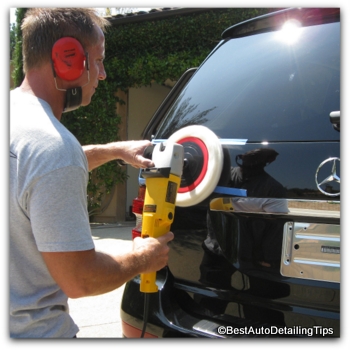
Why Pros Use Them (The Auto Body World)
In high-volume auto body and collision repair shops, speed and raw leveling power are everything. When a car comes out of the paint booth with fresh clear coat, the clock is ticking, and the rotary buffer is the ultimate tool for the job.
- Leveling Fresh Paint and Sanding Marks: Freshly sprayed clear coat often has texture (orange peel) or dust nibs that must be wet-sanded down using 1500 to 3000 grit sandpaper. A high-speed rotary buffer can pull out these deep sanding scratches across an entire vehicle much quicker than a dual-action buffer.
- Time is Money: Because a rotary transfers 100% of its motor's energy into direct circular friction, it works up to three times faster than a dual-action (DA) polisher. In a body shop where multiple cars need to be turned over daily, standard orbital machines are simply too slow for initial heavy cutting.
- Zero Pad Stalling: Body panels are full of complex curves, body lines, and tight recesses. When a DA polisher hits a sharp curve or a concave surface, the orbital safety mechanism often causes the pad to stop spinning (stall). A rotary buffer has direct-drive mechanical leverage; it will never stall, maintaining constant cutting speed regardless of the panel's shape.
Why Beginners and Most Detailers Don't
While the body shop world relies on the rotary, the vast majority of modern detailers and weekend enthusiasts have migrated entirely to Dual-Action (DA) orbital polishers. The reasons come down to safety, finish quality, and technological shifts.
- The "Burn-Through" Risk: Because a high-speed buffer generates intense heat on a single, localized axis, it takes only a split second of operator error to burn straight through the clear coat—especially on sharp body lines or plastic bumpers where heat dissipates slowly. Once you burn through the clear coat, the only fix is a costly trip back to the body shop for a repaint.
- The Nightmare of Holograms: For a beginner or intermediate user, a rotary almost always leaves behind holograms (also called buffer trails or micro-marring). These are ultra-fine, circular tracks left by the spinning abrasives that look like greasy, reflective holograms under direct sunlight. Getting a perfectly flawless, swirl-free finish with a rotary requires a significant level of technique and pad control.
- The Steep Learning Curve: Controlling a high-speed rotary is a physical battle. The machine wants to "walk" or run away from you across the panel based on the direction the pad is spinning. Keeping the pad perfectly flat, managing the speed, and tracking your arm movement requires more skill than that of a dual-action buffer.
- Evolution of DA Polishers and Modern Compounds: Ten or fifteen years ago, you had to use a rotary for heavy defect removal because orbital machines were weak. Today, modern long-throw DA polishers combined with advanced micro-abrasive polishes can remove heavy scratches safely and quickly, without the risk of burning the paint or leaving buffer trails. For most detailers, the safety and guaranteed swirl-free finish of a modern DA outweigh the speed advantage of a rotary.
Dual-Action, Random Orbital Buffers
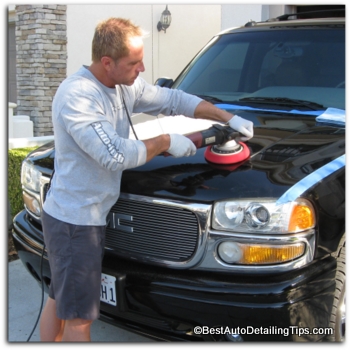
- Also called dual-action, or DA polishers.
- These buffers have (2) points of rotation or movements.
- They both spin and oscillate (vibrate).
- Considered the safest choice in choosing a car buffer due to its "random" rotation/spinning.
- Think of it like this: The earth spins on a single axis point, while rotating around the sun.
- The
reason these types of car polishers are so safe is that when too much,
or enough pressure is put upon the polisher, the polishing head stops
spinning and only remains "vibrating" or oscillating at that point. This
is like a safety feature that prevents excessive heat/friction build-up
by inexperienced people.
- The very reason these polishers are so safe, is the very reason of their biggest limitation. (as a skilled detailer, you don't necessarily want the polishing head to ever stop spinning and oscillating. Essentially you give up a certain level of control as you are limited by the machine)
- The best place to start if you are a true beginner in virtually everyone's opinion. And this includes me! If you are a true beginner and you want a very simplified approach to car polishing, I recommend you go to "Car Polishing for Beginners" and see exactly the route I recommend.
- The "go-to" car polisher for what many people refer to as a swirl free finish. (no holograms)
Forced Rotation Dual-Action Buffers
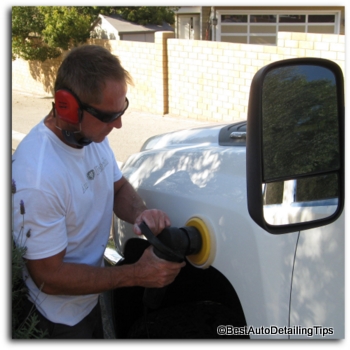
- Also a dual-action polisher or positive drive dual-action buffer.
- Different than the random orbital in that both the spinning and oscillating (vibrating) are gear driven.
- Regardless of pressure you put onto the machine while polishing, both the spinning and oscillating will remain constant.
- Because these polishers are gear driven and not "random", they will prove to be a bit harder to control when polishing.
- Some people will consider a positive drive dual action polisher as "less" safe than a true random orbital.
- The positive drive action also means you remain in more control when polishing since you will not be limited by the machine itself.
- Considered by many professional detailers as the best choice in a car buffer as you get the benefits of being in control, without the dangers associated with the high speed buffers.
- Because even a positive drive orbital buffer cannot produce the same level of friction and heat of a rotary, you will be limited to the type of work you can do, or how fast you can get to the finished result.
- The "go-to" car polisher to produce what many call a swirl free, or hologram free finish.
Which Buffer is Right for You?
The big question of the moment!!
Let me see if I can reduce this down to an incredibly simple answer for you:
"A dual-action, random orbital car polisher"
This is your answer and the answer for virtually anyone reading this page.
NOTE: As a rule, the industry now refers to these as just dual-action, or DA buffers.
Which you can see which car polisher and polishing kit I recommend by going to "Car Polishing for Beginners"
Darren's Professional Tips:
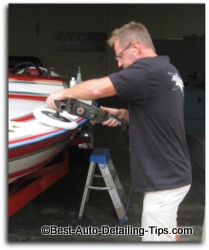
Let's do a review of what we have learned:
- High speed buffers have developed a bad reputation due to improper training of guys using them, which then delivers endless stories of mistakes and problems. (It is the person using the high speed buffer, not the buffer itself)
- The newer models start at a very low 600 RPM speed and are as safe as any orbital buffer. (most beginners do not realize the huge difference this makes in terms of the initial learning curve)
- Now a greater range of jobs and users can enjoy these quality built machines. (due to the very low operating speed these high speed polishers can be set, any beginner can safely and confidently "ease" their way towards mad skills! But the reality is that most people will find no need to learn how to use a high speed buffer.)
- Any of the buffers from this page would make my list of top picks for car polishers. (that link will take you to my boat polisher page, but it has all my top picks for the high speed polishers I recommend)
- I recommend orbital car polishers to any beginner as a rule.
- Because of my experience, I can do the heavy lifting of compounding, then dial down the operating speed of the high speed polisher, switch from a wool pad to a foam pad, and finish the paint to a swirl free, hologram free finish.
- So in a perfect world, you might come to the conclusion that you will eventually want both a high speed polisher, and a quality random orbital (DA buffer). But since it's not a perfect world and you are trying to decide; I say the random orbital dual-action polisher is the go-to choice for most guys.
I hope this has helped!
Sincerely,
Darren Priest
- Home
- Car Polish
- This Page
|
|

Thank you for your support of my website. I spend massive amounts of time bringing you my best car care tips that I bring from my 30+ years of experience as a professional detailer.
Sincerely,


Any time you use one of the Amazon links on this website and make a purchase, I earn a small commission (very small). This does not change the price you pay at Amazon, it simply means I earn a commission.
I hope you come back whenever you have any additional questions!